
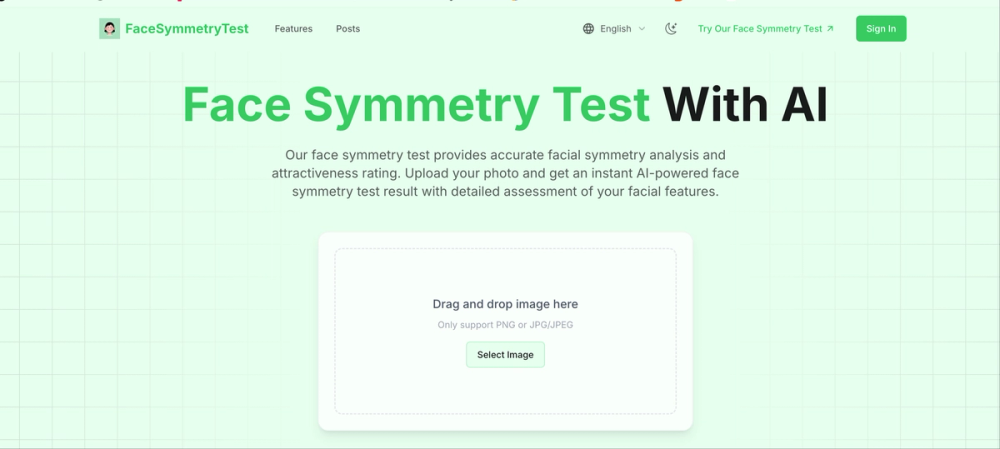
Face Symmetry Test Review
Introduction
Face Symmetry Test is a web-based facial analysis tool that uses AI to evaluate facial symmetry from an uploaded photo. The product is positioned as a fast way to generate symmetry scores, feature-level analysis, and visual feedback for people who want a clearer view of facial balance and harmony.
From the public site, the experience appears designed for quick self-service use. Users upload a front-facing image, let the system analyze visible facial landmarks, and receive a report that includes measurements, scoring, and suggestions tied to the results.
Key Features
- AI-powered facial symmetry analysis based on uploaded photos
- Detailed symmetry reports with measurements and visual guides
- Multi-point facial analysis for a broader symmetry assessment
- Real-time face rating and near-instant result generation
- Progress tracking for comparing results over time
- Optional secure photo storage for saving analysis history
The strongest visible differentiator is the emphasis on report depth rather than a single score. The site repeatedly highlights detailed assessment, visual explanations, and facial landmark analysis, which suggests the tool is meant to be more interpretive than a basic novelty checker.
Another notable feature is the guidance around image quality. Face Symmetry Test tells users to submit a front-facing, close, and clear photo with only one face in frame. That kind of onboarding matters because it sets expectations for better results before the analysis even begins.
Use Cases
Face Symmetry Test is most relevant for individuals who want a structured way to review facial balance instead of relying on casual visual judgment. A user can upload a photo and get a symmetry-focused report that may be easier to interpret than a general beauty or selfie app score.
The website also points to use cases beyond personal curiosity. Testimonials and copy on the page mention photographers, makeup artists, and healthcare-related professionals as potential users. While those examples are presented on the site rather than independently verified, they indicate the product is trying to serve both everyday users and people who discuss facial proportions as part of their work.
A practical use case is progress tracking. The product says users can save results and compare changes over time, which may appeal to people monitoring appearance changes, documenting facial exercises, or simply repeating the same test periodically under similar photo conditions.
Pricing
The public-facing pages emphasize that users can start a face symmetry test, and the site includes language such as "Start Free Face Symmetry Test." However, a full pricing table, plan breakdown, or billing structure is not clearly exposed in the provided source material. Based on the visible content alone, it is safest to say that some form of free entry point is advertised, but the exact pricing model is not clearly documented on the public site evidence used for this review.
User Experience and Support
The interface appears straightforward. The workflow is presented in a short sequence: upload a photo, let the AI run the analysis, and review the resulting symmetry report. The site also uses examples of analysis output, percentage-style scores, and visual report language to make the process easier to understand before a user commits a photo.
Support and guidance are visible, but not deeply documented in the source evidence. The site provides photo-taking tips to improve result quality and includes an FAQ that addresses accuracy, privacy, interpretation, frequency of use, and support. It also mentions contact through email or social media, with a stated response window of around 24 hours, though deeper support resources such as a formal knowledge base or documentation hub are not clearly shown in the captured material.
Technical Details
Face Symmetry Test describes its core engine in broad terms as AI-powered analysis with facial landmark detection, symmetry assessment, and computer-vision-style measurement logic. The public copy refers to multiple facial points, real-time processing, and score generation based on visible facial features.
At the same time, the site does not clearly expose a detailed technical stack, API documentation, model architecture, or platform integrations in the provided source material. That means the technical picture is enough to understand the product category, but not enough to make specific claims about frameworks, deployment, or developer-facing capabilities.
Pros and Cons
Pros
- Clear and simple workflow centered on photo upload and instant analysis
- Report-oriented output with visual guides and measurement context
- Includes practical photo instructions that can improve analysis quality
- Mentions progress tracking for users who want repeated comparisons
- Privacy and secure photo handling are addressed directly in the FAQ copy
Cons
- Pricing structure is not clearly visible in the provided public evidence
- Technical implementation details are described only at a high level
- Accuracy claims rely mainly on the product's own site messaging
- Results may depend heavily on photo quality, framing, and lighting conditions
- Support options are mentioned, but the broader support experience is not fully visible
Conclusion
Face Symmetry Test presents itself as a focused AI facial analysis tool for people who want more than a simple attractiveness score. Its most visible strengths are fast analysis, detailed symmetry reporting, visual feedback, and repeat-use features such as progress tracking.
For users comparing face symmetry tools, the product looks approachable and purpose-built. The main limits are around pricing transparency and the lack of deeper public technical detail, but the site does provide enough evidence to show a clear workflow and a well-defined use case.