
Nano Banana Review
Introduction
Nano Banana is an AI image editor built around a simple idea: you upload a photo, type the change you want, and the platform generates the edit in seconds. Based on the public site, the product is positioned for people who want faster visual edits without learning a traditional layer-based editor.
The homepage leans heavily on speed and ease of use. It presents Nano Banana as a text-driven photo editing tool for casual creators, content teams, and users who want quick visual changes such as background removal, facial expression adjustments, style changes, and other prompt-based edits.
Key Features
- Text-based image editing that lets users describe changes in plain language rather than navigating a complex interface.
- Very fast edit flow, with the site claiming results can appear in around 1-2 seconds for common tasks.
- Broad input flexibility, with the upload area described as working with selfies, product photos, pets, and other image types.
- Anime-to-real image transformation for turning illustrated characters into more natural-looking visuals while aiming to keep the subject consistent.
- AI storyboard generation through the Nano Banana AI Avatar workflow, which the site says can create up to 6 images with movement, storytelling, and expressive emotion.
- One-click style and cleanup examples shown on the page, including removing a person in the background or applying a retro filter.
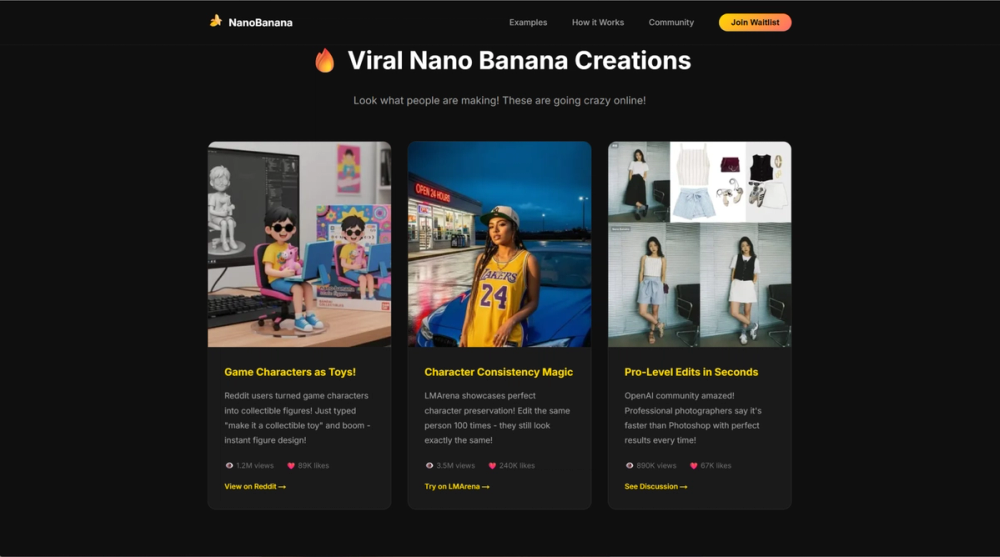
- Character consistency messaging that highlights repeated editing of the same subject while keeping the person visually recognizable across outputs.
Use Cases
Nano Banana appears well suited to people who need quick edits without opening a heavyweight design tool. A creator working on social posts, short-form content, or visual experiments could use text prompts to make small but meaningful changes fast, especially when the goal is speed over manual precision.
The examples on the homepage also suggest a fit for stylized image generation. Anime-to-real conversion, toy-style character transformations, and storyboard creation point to entertainment, fandom, and concept-visual use cases where users want to explore different looks from a starting image.
There is also a practical product-photo angle in the site messaging. Because the upload flow is described as working with product images as well as portraits, Nano Banana may appeal to sellers, marketers, and side-project founders who want to refresh visuals, test presentation ideas, or generate alternate versions of an image without arranging a full shoot. That said, the public site does not clearly document workflow limits, export controls, or business-grade editing safeguards.
Pricing
Pricing is not clearly explained on the public homepage content captured for this run. The site repeatedly uses the phrase "Try For Free" and also states "No credit card, no signup," which strongly suggests there is at least a free entry experience. However, no detailed plan tiers, usage caps, subscription levels, or paid feature breakdowns are clearly exposed in the available evidence, so anyone evaluating Nano Banana for regular work would likely need to inspect the app directly for fuller pricing details.
User Experience and Support
The clearest user-experience theme is simplicity. The homepage repeatedly frames the product as something you can use by typing natural requests such as "remove background" or "add a smile," which lowers the barrier for people who do not want to learn traditional editing controls. The interface messaging suggests an upload-and-prompt workflow that is intentionally lightweight.
Support information is much less clear. The captured public content includes testimonials, community-style references, and promotional comparisons, but it does not clearly show a help center, onboarding documentation, live chat, or named support channels. As a result, ease of starting looks strong from the public site, while formal support depth is not yet easy to verify from the visible homepage alone.
Technical Details
From the public site, Nano Banana is best understood as a prompt-based AI image editing platform. The clearest technical signal is the "edit through language, not layers" framing and the emphasis on generating changes from short text instructions. The site also points to image consistency, rapid rendering, and an AI avatar storyboard mode.
Beyond that, the technical stack is not clearly disclosed. There are no visible details in the captured evidence about model providers, APIs, deployment architecture, file handling limits, integrations, or supported export formats. For technical buyers, that means Nano Banana currently presents more as an accessible product experience than as a deeply documented platform.
Pros and Cons
Pros
- Very clear value proposition centered on fast, text-based image editing.
- Low-friction workflow that appears easy for non-designers to understand.
- Diverse creative examples, including anime conversion, storyboard generation, and simple one-click edits.
- Free-entry messaging is prominent, which may reduce evaluation friction.
- Strong emphasis on fast turnaround and repeatable subject consistency.
Cons
- Public pricing details are limited, making it hard to compare plans or long-term cost.
- Support resources and service structure are not clearly documented on the visible homepage.
- Technical transparency is light, with little information about stack, integrations, or advanced controls.
- Some homepage claims are presented in a highly promotional tone and would need hands-on validation for professional workflows.
- The public site does not clearly explain usage limits, output ownership, or enterprise-oriented safeguards.
Conclusion
Nano Banana is positioned as a fast, easy-to-use AI image editor for people who want to change photos by typing simple instructions instead of learning a traditional editing tool. Based on the visible homepage content, its biggest strengths are accessibility, speed, and creative flexibility across portraits, stylized visuals, and quick image transformations.
For users who want a lightweight way to test prompt-based image editing, Nano Banana looks approachable and easy to try. For teams that need deeper pricing clarity, documented support, or technical integration detail, it would be worth reviewing the product experience more closely before relying on it for production workflows.