
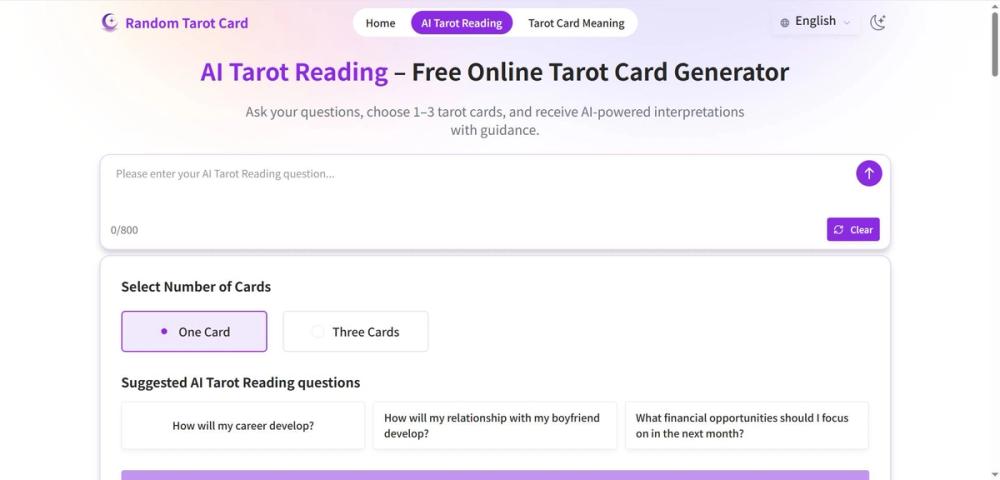
Random Tarot Card Review
Introduction
Random Tarot Card is a free web-based tarot reading tool built around quick card draws, AI-assisted interpretations, and several reading modes. Based on the public site, it is designed for people who want lightweight spiritual reflection online without installing anything or creating a complex setup. The product combines a random tarot card generator with guided reading options such as love tarot, daily tarot, and yes-or-no tarot.
Key Features
- Lets users draw from either the full 78-card deck or only the 22 Major Arcana cards.
- Supports both upright and reversed card results for broader interpretation.
- Includes multiple reading modes, including AI Tarot Reading, Love Tarot, Yes or No Tarot, and Daily Tarot.
- Offers a built-in randomizer so users can generate cards instantly from the browser.
- Adds a Healing Chat experience for follow-up reflection after a reading.
- Presents step-by-step usage guidance directly on the site for first-time visitors.
Use Cases
Random Tarot Card is most useful for people who want a fast way to do a tarot draw online and get immediate interpretation support. Someone exploring a personal question can choose a reading type, generate a card, and review either the card meaning or the AI-supported explanation without needing a physical deck.
It also fits casual daily-use scenarios. The site explicitly highlights daily tarot, love tarot, and yes-or-no readings, which makes it suitable for visitors who want a short reflective ritual, a relationship-focused reading, or a simple binary-style prompt for personal decision-making.
A third use case is guided interpretation. The public copy mentions Healing Chat and AI tarot assistance, so the platform is not limited to showing a random card. It is also positioned as a space where users can continue reflecting on the result and seek more contextual guidance after the draw.
Pricing
The public site repeatedly describes Random Tarot Card as free to use. However, the pricing structure is not clearly explained in detail on the visible page content provided here. There is a navigation mention of pricing, but no plan breakdown, billing tiers, or feature gating is clearly exposed in the source evidence, so users should review the live site directly if they need exact commercial terms.
User Experience and Support
From the visible structure, the product appears intentionally simple. The site walks users through selecting a deck, choosing a reading type, generating cards, and then reviewing the outcome. That step-by-step flow lowers the barrier for first-time visitors who may not be deeply familiar with tarot systems.
Support appears to be embedded more in the product experience than in a traditional software help model. The clearest guidance signals are the on-page instructions, AI Tarot Reading, and Healing Chat. Public evidence does not clearly show a dedicated help center, live support channel, or formal documentation library, so expectations should stay focused on in-product guidance rather than extensive customer support infrastructure.
Technical Details
Based on the public copy, Random Tarot Card is a browser-based platform that uses AI-powered interpretation as part of the reading experience. It also supports multiple reading paths, card randomization, and both upright and reversed meanings. Those are meaningful functional signals for users evaluating how the experience works at a high level.
That said, the public page evidence does not clearly expose the underlying technical stack, API architecture, programming language, or external integrations. Any deeper technical evaluation would require additional documentation beyond what is visible on the site content gathered for this workflow.
Pros and Cons
Pros
- Free entry point for online tarot reading.
- Multiple reading modes cover different user intents.
- Supports both full-deck and Major Arcana-only draws.
- Includes upright and reversed interpretations.
- Clear step-by-step flow makes the tool approachable.
Cons
- Public pricing details are not clearly broken down beyond free-use messaging.
- Technical architecture and integrations are not visible from the public evidence.
- Support options appear limited to on-site guidance and AI-led interactions.
- The site copy emphasizes breadth of reading types more than methodological transparency.
Conclusion
Random Tarot Card is a practical choice for users who want instant online tarot readings with more structure than a basic one-card draw. Its strongest visible value is accessibility: free access, multiple reading formats, and AI-assisted interpretation in one place. For users comfortable with browser-based spiritual tools, it offers a straightforward way to explore tarot guidance, while those who need detailed pricing or technical transparency may want to verify those details on the live site first.