
SaasHunt Review
Introduction
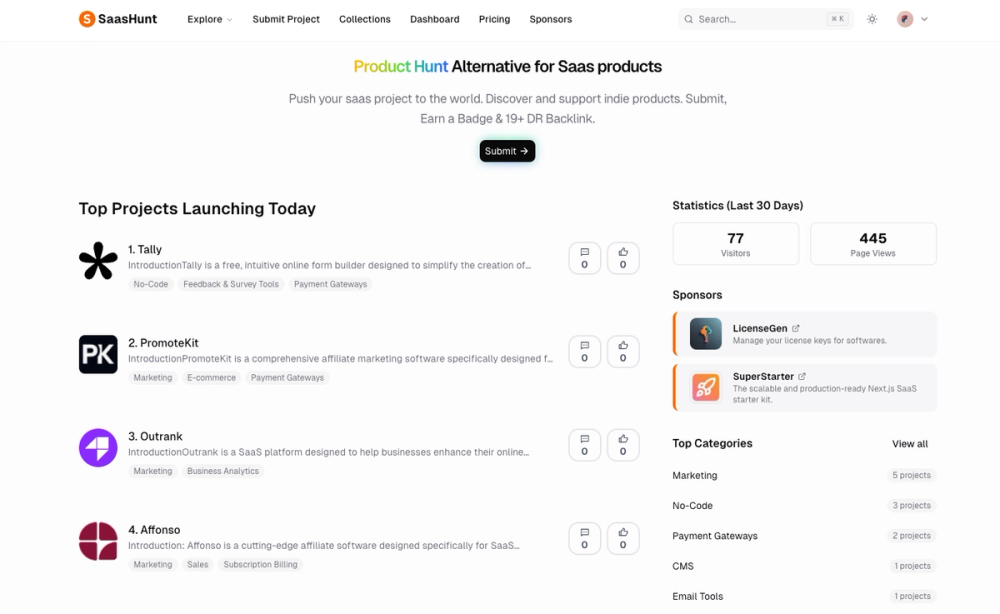
SaasHunt is a product discovery platform focused on SaaS and other tech products. The site presents itself as a Product Hunt alternative for SaaS products, with daily launches, community upvotes, category browsing, and submission options for founders who want more visibility.
From the public homepage, SaasHunt appears designed for two groups at once: builders who want to submit a project, and readers who want to discover new tools. The main value proposition is straightforward: help indie products get seen, collect support signals, and gain extra distribution through a curated launch-style listing environment.
Key Features
- Daily launch listings that highlight new tech products and organize them into time-based sections such as launches today, yesterday, last week, and last month.
- Product discovery pages that surface a mix of SaaS, AI, marketing, developer, and productivity tools in a browsable feed.
- Community voting signals shown alongside listings, which helps visitors quickly spot products getting traction on the platform.
- Category and collection navigation that makes it easier to browse products by topic rather than relying only on a chronological feed.
- A direct project submission flow promoted prominently on the homepage for founders who want to list a product.
- Sponsor placements, newsletter signup, blog content, and leaderboard-style sections that extend the platform beyond a simple directory page.
Use Cases
SaasHunt is most useful for founders, indie hackers, and small SaaS teams that want a lightweight way to present a new product in front of an audience already browsing software launches. If you are preparing a launch, the platform gives you a public page where your product can sit next to other newly released tools, which can help with early awareness and discovery.
It also works as a research destination for people looking for new software ideas, niche tools, and emerging products. Because the homepage is structured around recent launches and top-performing entries from different periods, it supports quick scanning for trends rather than forcing users into a deep search workflow.
A third use case is backlink and visibility-focused promotion. The homepage explicitly mentions submitting a project to earn a badge and a 50+ DR backlink. That claim is part of the visible marketing copy, so for some founders the appeal may be less about community discussion and more about directory presence, referral visibility, and launch distribution.
Pricing
The site navigation includes a pricing page, which indicates that SaasHunt likely has a paid component for submissions, placements, or platform access. However, the public homepage content captured here does not clearly expose plan tiers, billing details, or what is included in each pricing option. It is safer to say that pricing exists, but the specifics are not clearly visible from the provided source evidence.
User Experience and Support
The public interface looks built for quick scanning. New launches, top products by time period, category labels, sponsor placements, and blog links are all visible from the homepage, which makes the platform feel more like a modern launch directory than a static link list. The submission entry point is also easy to spot, which matters for founders who want a short path from landing on the site to listing a product.
Support options are not clearly detailed in the captured page content. Aside from visible navigation items like sign in, sign up, submit project, newsletter subscription, and policy links, there is no strong evidence here of a help center, onboarding documentation, live chat, or explicit support channels. Users may need to explore deeper pages to understand what support looks like in practice.
Technical Details
From the visible site content, SaasHunt supports structured browsing across categories, rankings, and time-based launch sections. The homepage also includes user account actions, theme toggling, sponsor modules, and blog content, which suggests a more complete web application rather than a basic static directory.
That said, the public source material does not clearly expose the underlying tech stack, API availability, developer integrations, or infrastructure details. Any claim about frameworks, hosting, submission automation, or backend architecture would be speculative, so those details should be treated as not publicly confirmed from the evidence provided.
Pros and Cons
Pros
- Clear positioning as a SaaS-focused alternative to broader product launch platforms.
- Daily launch structure makes the site useful for both discovery and product promotion.
- Submission flow is prominently featured, reducing friction for founders.
- Category browsing, rankings, and collections improve scanability.
- Visible backlink-oriented value proposition may appeal to teams focused on SEO and launch distribution.
Cons
- Pricing details are not clearly visible from the captured homepage evidence.
- Public support and onboarding resources are not clearly exposed in the provided source material.
- The homepage contains a large volume of launch content, which may feel crowded for first-time visitors.
- It is not fully clear from the visible content how products are curated, ranked, or reviewed after submission.
- Some users may want deeper filtering, moderation, or submission detail pages before deciding whether to use it.
Conclusion
SaasHunt looks like a practical discovery and launch platform for SaaS products, especially for founders who want another place to showcase a release outside of larger mainstream directories. Based on the visible homepage evidence, its strengths are clear positioning, frequent launch visibility, and a submission-first workflow, while details such as pricing depth, support, and platform mechanics require a closer look on internal pages.