
Introduction
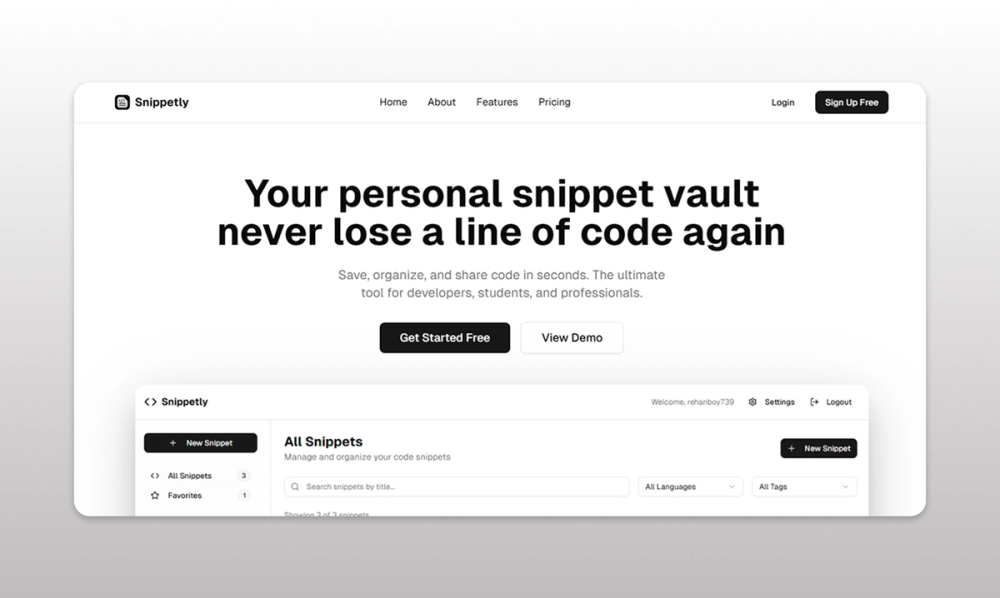
Snippetly is presented through its public website as Snippetly - Code Snippet Manager | Save & Organize Code Snippets Online | Free online code snippet manager for developers. Save, organize, search, and share code snippets instantly. GitHub sync, syntax highlighting, 50+ languages. Join 10,000+ developers. Free forever with 50 snippets. | Your Supercharged Code Memory Partner | Stop losing your code snippets | Everything you need to manage code snippets. The main value for readers is that the official page gives enough visible context to decide whether the product belongs in an evaluation shortlist. A careful user should review Snippetly directly and confirm unclear details such as pricing, support, technical limits, and workflow fit before relying on it.
Key Features
- Free online code snippet manager for developers. Save, organize, search, and share code snippets instantly. GitHub sync, syntax highlighting, 50+ languages. Join 10,000+ developers. Free forever with 50 snippets.
- Your Supercharged Code Memory Partner
- Stop losing your code snippets
- Everything you need to manage code snippets
- GitHub Sync Integration
Use Cases
Snippetly appears useful for people who want to understand whether a developer tool product matches a specific workflow or evaluation need. The public page can help with early screening because it shows the product name, positioning, and visible claims in one place.
For teams comparing options, Snippetly can be reviewed alongside similar products to see whether its stated purpose, visible features, and category fit the problem at hand. The practical next step is to check the official page, look for current access details, and confirm whether the product supports the exact use case, team size, region, or technical environment required.
The available site copy should be treated as a starting point rather than a complete evaluation. If the product will be used in a professional, client-facing, or recurring workflow, readers should verify reliability expectations, support coverage, data handling, and any usage restrictions that are not described clearly on the homepage.
Pricing
The public page includes pricing-related language: Up to 50 snippets Up to 5 folders Up to 5 boilerplates 10 snippets per folder Full search functionality Tags and favorites Most Popular Pro For power users and teams $29 one time Get Started What's Included Everything in Free Unlimited snippets Unlimited folders Unlimited boilerplates Team collaboration (coming soon) Advanced features Testimonials What people are Raving about us? See what our users have to say about Snippetly Free Resources Explore Our Code Snippet Library Browse our free collection of production-ready code snippets. Copy and use them in your projects right away. Is there a limit to how many snippets I can save? What programming languages are supported? Can I share my snippets with others? What is your pricing and refund policy? Ready to organize your code snippets? Join thousands of developers who have already transformed their workflow. Start building your personal snippet vault today. Readers should still verify current plan limits, billing terms, account requirements, and whether any usage-based restrictions apply before adopting the product.
User Experience and Support
The visible page structure is suitable for a first-pass product review because it exposes the basic identity, headings, and short descriptive copy. That helps visitors understand the product's public positioning before spending more time on sign-up, sales contact, or deeper testing.
The site includes some support-related language: Save Snippets Quickly save code snippets with syntax highlighting for up to 50 languages Smart Search Find any snippet instantly with useful search across titles, tags, and code content Organize Tag snippets, mark favorites, organize in folders, and filter by language for perfect organization Coming Soon Share & Collaborate Share snippets with your team or make them public for the community Lightning Fast Built for speed - save, search, and copy snippets in milliseconds Team Ready Perfect for individual developers and teams of any size Integration GitHub Sync Integration Seamlessly sync your code snippets between Snippetly and GitHub. Keep your snippets backed up and accessible across all your development environments. Browse Code Library FAQs Frequently Asked Questions Everything you need to know about Snippetly Is there a limit to how many snippets I can save? What programming languages are supported? Can I share my snippets with others? What is your pricing and refund policy? Ready to organize your code snippets? Join thousands of developers who have already transformed their workflow. Start building your personal snippet vault today. Evaluators should still confirm documentation depth, response channels, onboarding help, and troubleshooting coverage for their own use case.
Technical Details
Visible technical signals include: Save, organize, and share code in seconds. The ultimate code management tool for aspiring developers, and SaaS Builders Instant search across all your snippets Organize with tags and favorites Share snippets with your team // Before Snippetly ❌ Lost in scattered files ❌ No organization system ❌ Hard to share with team // After Snippetly ✅ Centralized snippet vault ✅ Smart tagging & search ✅ Easy sharing & collaboration Features Everything you need to manage code snippets useful features designed to make your development workflow more efficient Save Snippets Quickly save code snippets with syntax highlighting for up to 50 languages Smart Search Find any snippet instantly with useful search across titles, tags, and code content Organize Tag snippets, mark favorites, organize in folders, and filter by language for perfect organization Coming Soon Share & Collaborate Share snippets with your team or make them public for the community Lightning Fast Built for speed - save, search, and copy snippets in milliseconds Team Ready Perfect for individual developers and teams of any size Integration GitHub Sync Integration Seamlessly sync your code snippets between Snippetly and GitHub. Keep your snippets backed up and accessible across all your development environments. Is there a limit to how many snippets I can save? What programming languages are supported? Can I share my snippets with others? What is your pricing and refund policy? Ready to organize your code snippets? Join thousands of developers who have already transformed their workflow. Start building your personal snippet vault today. The page also references GitHub. The site does not fully explain implementation details, data sources, or operational limits, so technical evaluators should verify those points directly.
Pros and Cons
Pros
- The public page provides a clear starting point for identifying the product's broad purpose.
- Visible headings and description text support quick scanning for initial evaluation.
- The official website gives readers a direct place to verify current positioning.
- The product can be compared with alternatives without assuming unsupported outcomes.
Cons
- Pricing and plan boundaries may need direct verification.
- Support and documentation routes may not be fully clear from the visible page copy.
- Technical depth, integrations, data handling, and operational limits may require further checking.
- The public page should not be treated as proof of performance, reliability, compliance, or measurable results.
FAQ
What is Snippetly?
Snippetly is presented on its public website as Snippetly - Code Snippet Manager | Save & Organize Code Snippets Online. The visible description says: Free online code snippet manager for developers. Save, organize, search, and share code snippets instantly. GitHub sync, syntax highlighting, 50+ languages. Join 10,000+ developers. Free forever with 50 snippets.
Who is Snippetly suited for?
It appears suited for users or teams evaluating tools in the developer tool category. The right fit depends on the reader's workflow, budget, expected feature depth, support needs, and technical requirements.
What can users verify from the public site?
Users can verify the product name, homepage, visible title, page description, and the claims shown in the public copy. Visible page signals include Your Supercharged Code Memory Partner, Stop losing your code snippets, Everything you need to manage code snippets, GitHub Sync Integration.
Does Snippetly publish pricing or access details?
The page includes some pricing-related language, but readers should confirm current plans, limits, and billing terms before adoption.
What support or documentation should evaluators look for?
Evaluators should look for help docs, onboarding material, contact options, tutorials, and troubleshooting guidance. These details matter if Snippetly will be used regularly rather than reviewed once.
What technical questions should a team ask before using it?
A team should ask whether Snippetly supports the platforms, integrations, exports, APIs, data sources, and operational limits required for its workflow. The public page is useful for orientation, but it may not be a complete technical specification.
What is the main limitation of evaluating Snippetly from the homepage?
The main limitation is that homepage copy rarely explains every practical detail. Readers should verify pricing, support, technical constraints, update frequency, and real workflow fit before depending on the product.
Conclusion
Snippetly is worth reviewing when its public positioning matches the problem a reader is trying to solve. The official page provides a useful starting point, but a stronger evaluation requires checking current pricing, support, technical details, and fit for the intended workflow.