
AIGC 160 Review
Introduction
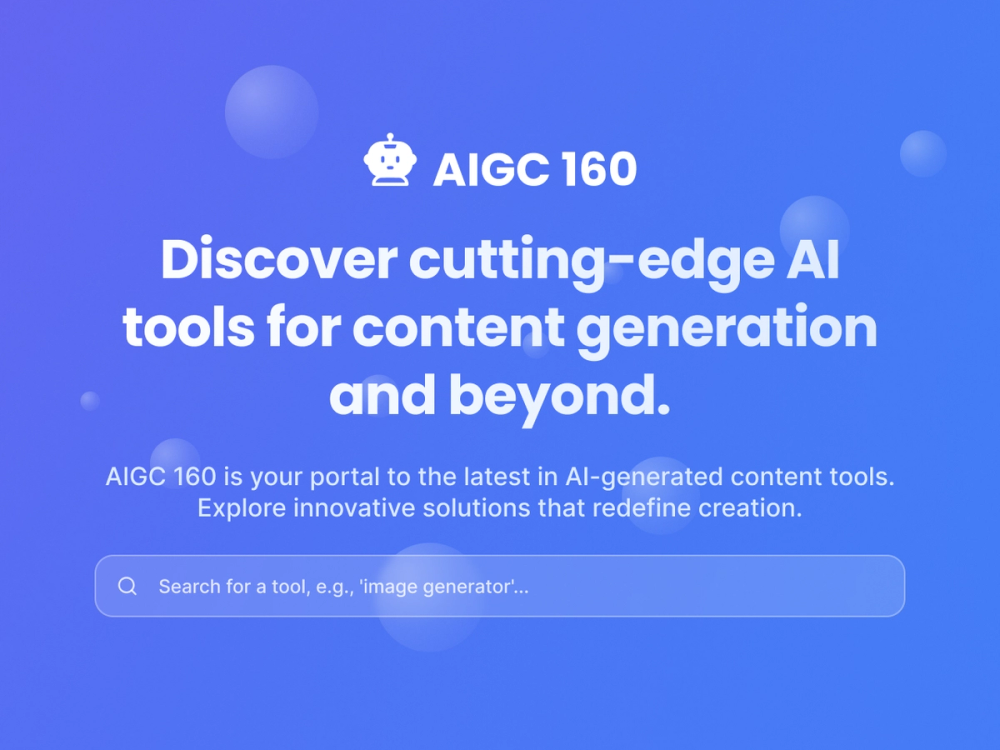
AIGC 160 is an AI content tools directory built around discovery and comparison. The site positions itself as a place to explore tools for writing, image generation, video production, and broader creative automation, making it easier for users to review different products in one browsing experience.
From the public page content, AIGC 160 is aimed at creators, marketers, researchers, and teams evaluating AI software for practical content workflows. Instead of focusing on one narrow category, it covers a wide spread of AI product types and organizes them so visitors can compare tools by category, use case, and workflow context.
Key Features
- Directory coverage across writing, image generation, video workflows, and creative automation.
- Category-based browsing that includes areas such as Content Creation, Writing, Video, SEO, Web Development, Design Tools, and many other software-related segments.
- Featured tool listings that surface newly added or highlighted products on the homepage.
- Submission flow for product owners who want to submit an AI tool for review and possible inclusion.
- Comparison-oriented listing structure that references category placement, pricing transparency, and workflow context.
- Free public browsing for users who want to discover and evaluate listed tools without paying to access the directory.
Use Cases
AIGC 160 is most useful for people who are actively researching AI tools and do not want to search across dozens of separate vendor sites. A marketer comparing writing assistants, an indie founder looking for launch-ready content products, or a creator exploring image and video generation tools can use the directory to narrow the field faster.
It also works as a lightweight discovery layer for teams that want broader market awareness. Because the site spans multiple categories rather than a single product type, it can help users spot adjacent tools they may not have considered, such as moving from text generation into video, image, analytics, or automation-related products.
For founders and tool operators, AIGC 160 also appears to function as a submission destination. The site explicitly states that users can submit their own AI content tool through the submission page for review, which gives early-stage products another channel for visibility inside a curated directory environment.
Pricing
The public site clearly states that AIGC 160 is free to use for browsing, viewing listings, and comparing AI tools. At the same time, it notes that individual products inside the directory may follow their own pricing models. Beyond that high-level statement, detailed pricing mechanics for the directory itself, such as paid placement, sponsorship, or premium listing options, are not clearly exposed in the visible source material.
User Experience and Support
Based on the visible page structure, AIGC 160 emphasizes straightforward browsing. The homepage includes search and navigation paths such as Latest, Explore, Submit, and Login, which suggests a simple discovery-first interface rather than a heavy editorial portal. The category layout and featured listings also support quick scanning for users who want to move directly into a niche like Writing, Image Generation, Video, or Launch Platforms.
Support details are only partially visible. The site includes standard pages such as Terms & Conditions and Privacy Policy, and it explains that submitted tools are reviewed before being added. However, public evidence for dedicated documentation, live chat, onboarding help, or a formal support center is not clearly exposed in the retrieved source.
Technical Details
Publicly visible technical detail is limited, so the safest conclusion is that AIGC 160 is a web-based directory experience with search, category navigation, listing pages, and a submission flow. The content strongly indicates that the platform is structured around AI software discovery and comparison rather than direct in-product creation.
The site also references a wide range of software categories, including browser-related and development-related areas such as Chrome Extensions and Web Development. That gives useful context about directory breadth, but the underlying stack, API model, hosting setup, or integration architecture for AIGC 160 itself is not clearly disclosed on the public page.
Pros and Cons
Pros
- Covers a broad range of AI content and creative software categories in one place.
- Makes tool discovery easier through category organization and featured listings.
- Free to browse, which lowers friction for researchers, founders, and creators.
- Includes a submission path for product owners who want directory exposure.
- Gives contextual clues for comparison through category and workflow framing.
Cons
- Publicly visible pricing details for the directory business model are limited.
- Support and onboarding information are not clearly described in the available source.
- Technical implementation details are not exposed for users who want deeper platform transparency.
- Some homepage text appears dense because many listings and categories are shown at once.
- The quality of comparison depth may vary depending on how much information each listed tool provides.
Conclusion
AIGC 160 is best understood as a focused AI tools directory for content and creative work, with coverage spanning writing, images, video, and related automation categories. It is a practical option for users who want a free way to discover and compare AI products, and for founders who want another place to submit an AI tool for review and visibility.
What stands out most is the directory's breadth and its emphasis on workflow-oriented discovery. What remains less clear from the public site is the depth of support, the full commercial model, and the technical foundation behind the platform.